
Custom software or ready-made SaaS: how to decide
The short answer
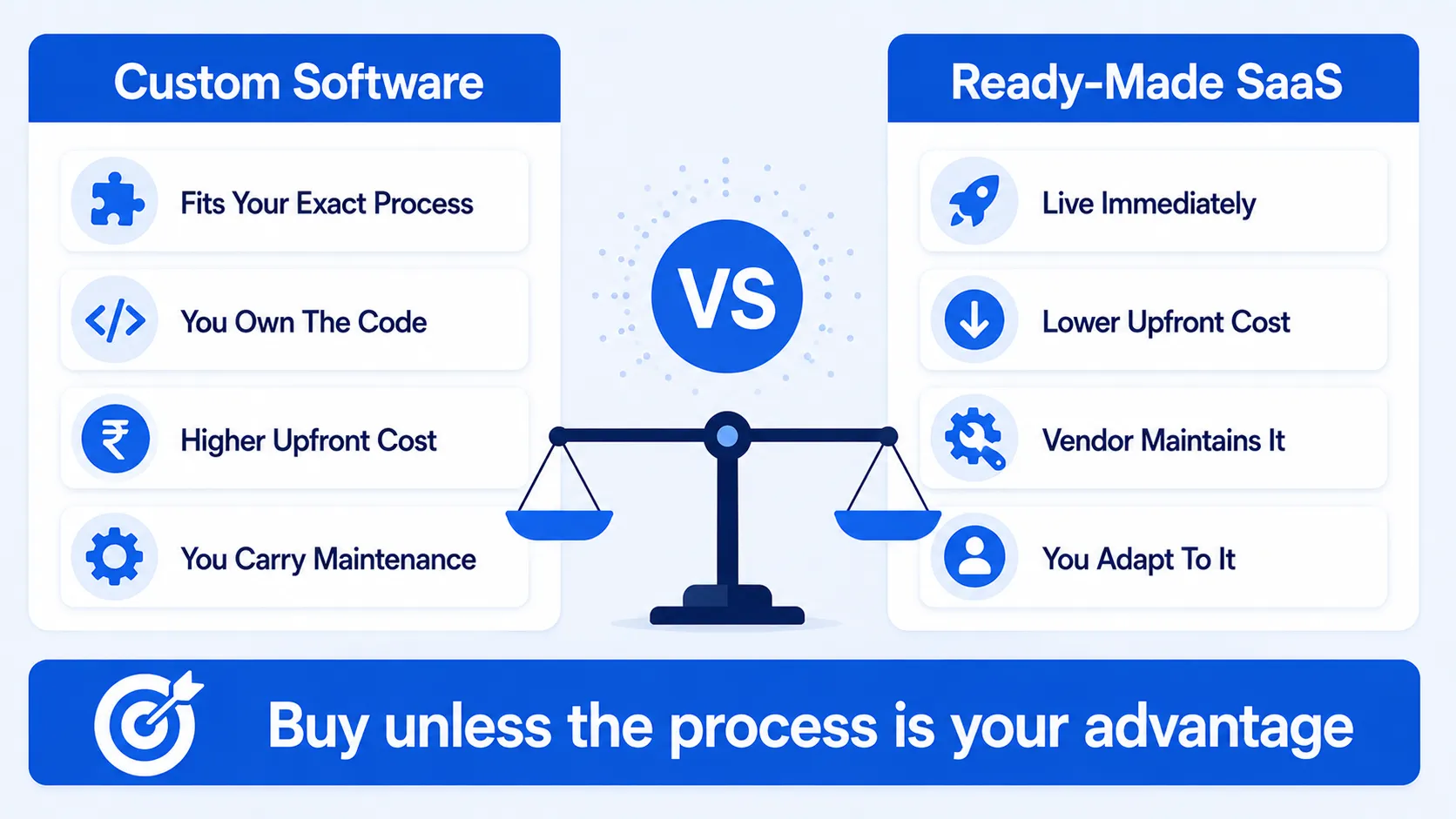
Buy ready-made unless your process is genuinely a competitive advantage, the subscription cost at your headcount exceeds what building would cost within three years, or the product forces a workflow that damages how you actually operate. For most businesses, most of the time, off-the-shelf wins. A vendor telling you otherwise before understanding your process is selling, not advising.
Start with the honest default
Ready-made software is the right answer more often than agencies admit, including this one. It is cheaper upfront, live immediately, maintained by somebody else, patched for security without you thinking about it, and supported by documentation and a community that already exists.
For accounting, email, payroll, helpdesk, storage and most CRM needs, a mature product will beat anything you commission. Those products have absorbed a decade of edge cases you have not thought of yet, and you get that for a monthly fee.
If you can run your business on a standard product, run your business on a standard product. The money saved is better spent on the part of your business that actually differentiates you.
The five questions that actually decide it
Is this process your competitive advantage?
If a competitor could buy the same software and operate identically to you, the process is not an advantage, it is plumbing. Buy plumbing. If your process is genuinely how you win, forcing it into a product's assumptions removes the thing that makes you different.
What does the subscription actually cost at your size?
Per-seat pricing scales with headcount. Twenty users at Rs 1,500 per user per month is Rs 3.6 lakh a year, or Rs 10.8 lakh over three years before add-ons and price increases. Run it at your size in three years, not today.
How much are you already paying in workarounds?
Someone exports to Excel every Friday and reformats it. Two systems hold customer data and neither is authoritative. Price that at salary cost and it frequently exceeds the software cost, and it is invisible until you look for it.
Do you need it to talk to something without an API?
Integration is where off-the-shelf breaks. If your operation depends on a legacy system, a bank file format, a government portal or a partner's non-standard feed, products rarely accommodate it and their roadmaps rarely will.
What happens if the vendor changes direction?
Pricing changes, features get deprecated, products get acquired and sunset. With SaaS you are a passenger. For a peripheral tool that is acceptable. For the system your entire operation runs on it is worth weighing.
The middle option most people miss
The choice is rarely all-or-nothing, and treating it as binary is how businesses end up with an expensive custom build they did not need or a product they are fighting daily.
Run standard products for standard functions, accounting and email and HR, and build only the piece that is genuinely yours, connected by an integration layer. This is usually the best cost-to-value ratio available.
It is also under-recommended, and it is worth being honest about why: it is a smaller sale for a development agency and a smaller sale for a SaaS vendor. Nobody in the room is incentivised to suggest it, which is exactly why you should consider it.
What custom actually costs you
Being straight about this, since we build custom software.
- You pay for the build, which is the number everyone focuses on and the smallest one over time.
- You pay for maintenance, because dependencies age, browsers change, security patches land and runtime versions reach end of life.
- You carry hosting and monitoring, or pay someone to.
- You own the bugs. There is no vendor support queue to escalate to.
- You need documentation and a handover plan, so the system does not depend on one person's memory.
Budget maintenance from the start. Custom software with no maintenance budget becomes legacy software within two years, and legacy software costs more to fix than it did to build.
A quick way to decide
| Your situation | The answer |
|---|---|
| Fewer than ten users, standard process, no unusual integrations, needed this month | Buy ready-made |
| The process is a real competitive advantage | Build custom for that piece |
| Subscription cost at your headcount exceeds the build within three years | Model both properly, then decide |
| Integration with something non-standard is unavoidable | Custom middleware between products |
| Most functions are standard but one is not | Do both, connected by an integration layer |
From our own projects
We have built full billing and document systems for clients, covering proforma invoice, quotation, delivery challan, purchase order, purchase invoice, tax invoice, credit note and debit note, with role-based access separating superadmin from employee. That is a case where custom was right, because the document set and approval rules were specific to how the client operates.
We have also told clients not to build. When the requirement turned out to be a standard CRM need with a preference attached rather than a genuine process difference, the honest answer was a product plus a small integration. That is a smaller invoice for us and the right answer for them, and an agency that never gives that answer is worth being cautious of.
Frequently asked questions
Weighing build against buy?
We build custom software and we will tell you when a product is the better answer. That conversation costs nothing.