
Payment gateway charges in India: what you actually pay
The short answer
Razorpay, PayU and Cashfree all sit around 2% plus GST for standard domestic transactions. Razorpay publishes a flat 2% with no setup or annual maintenance fee. Cashfree publishes a lower headline rate but multiple sources report an annual maintenance charge around Rs 4,999, which erases the advantage at low volume. PayU works largely on negotiated pricing. The percentage is not what decides your cost.
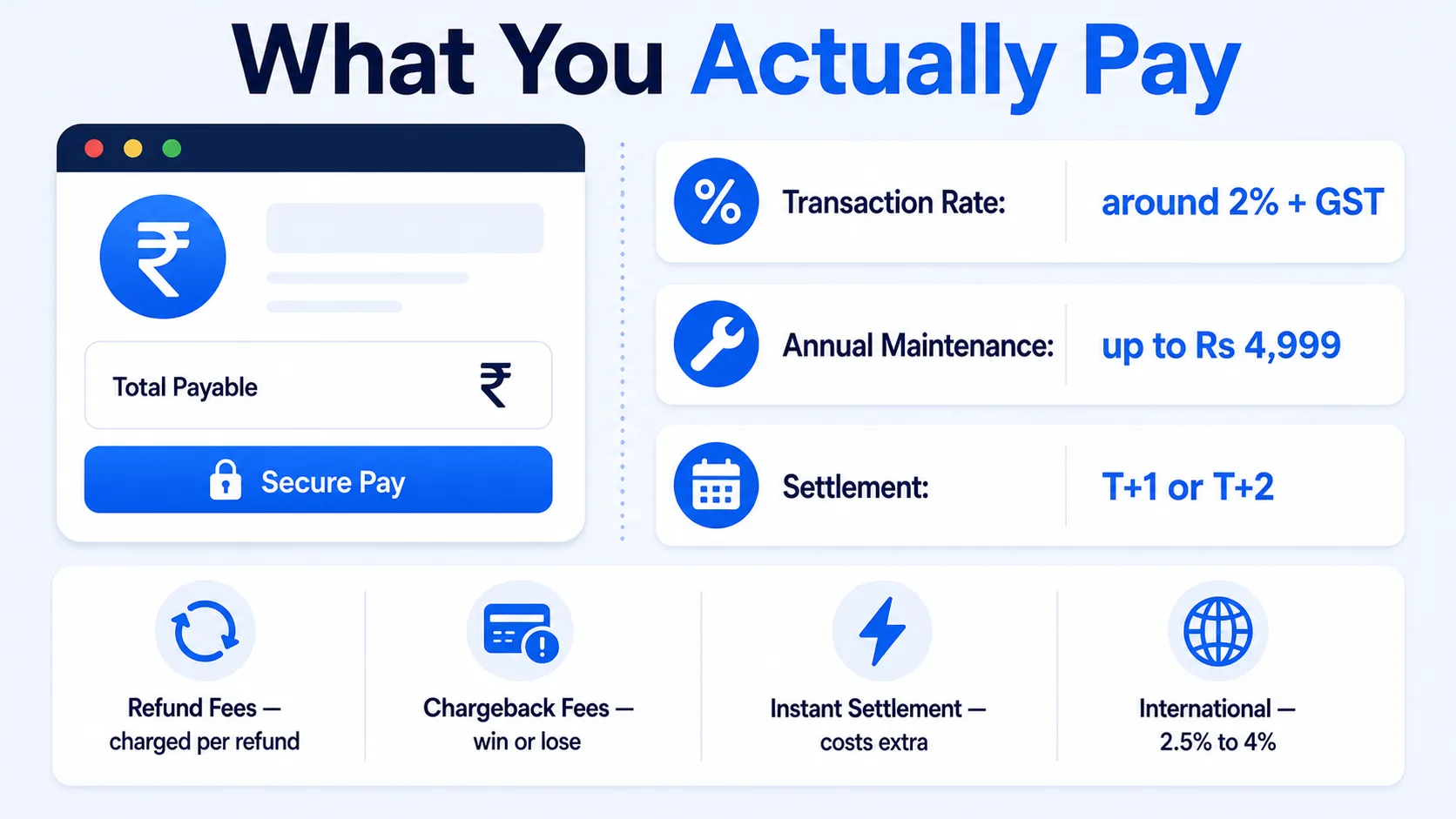
Rates below reflect what providers published as of August 2026 and vary by category, volume and negotiation. Confirm against the provider's own pricing page and your signed agreement.
What the three major gateways actually charge
The shortlist for most Indian startups and SMBs comes down to these three, and on the headline rate they sit close together.
Razorpay
2% + GST
No setup fee and no annual maintenance charge published. Widely considered the fastest to onboard and the strongest on developer experience and documentation.
Cashfree
1.75% - 1.95%
Published sources in 2026 disagree on the exact rate, which is itself a reason to confirm before assuming. Several report an annual maintenance charge in the region of Rs 4,999.
PayU
Around 2%
Pricing is typically negotiated rather than published, varying by transaction volume and business category. Strong on enterprise requirements and existing banking relationships.
Is the cheapest headline rate actually the cheapest?
Usually not, at low volume. The annual maintenance charge is what flips the comparison.
An annual maintenance charge of Rs 4,999 works out to roughly Rs 416 a month, and you pay it whether you process a single transaction or ten thousand. At Rs 2 lakh in monthly volume, a 0.25% rate advantage saves you Rs 500 a month, which is barely more than the AMC costs. The lower rate has bought you almost nothing.
At Rs 20 lakh in monthly volume, the same 0.25% advantage saves Rs 5,000 a month and the AMC becomes noise. The lower rate is now genuinely lower. Somewhere between those two points is a crossover, and where it sits depends entirely on your volume rather than on which gateway markets itself better.
The practical instruction is simple: take your own expected monthly volume, apply each provider's rate, add their fixed charges, and compare the annual totals. That arithmetic takes ten minutes and reverses the obvious answer more often than not.
The fees that comparisons leave out
Every one of these is disclosed somewhere in the agreement. Almost none of them make it to the pricing page.
Refund fees
Some gateways charge per refund, some do not. If you sell apparel, footwear or anything else with a high return rate, this stops being a rounding error and becomes a monthly line item worth negotiating.
Chargeback fees
Charged per dispute, and typically charged whether you win the dispute or lose it. A business with even a modest chargeback rate should ask for this number in writing before signing.
Instant settlement
T+0 settlement is available at additional cost, either as a percentage add-on or a per-transaction fee. Genuinely useful when working capital is tight, and expensive if switched on without doing the sums.
International transactions
Materially higher than domestic rates, with a per-transaction fee plus a percentage in the 2.5% to 4% range, before the currency conversion spread, which is usually buried in the exchange rate rather than shown as a fee.
What matters more than the transaction fee
- Transaction success rate. A gateway that fails more UPI attempts costs you far more in lost sales than a rate difference costs in fees, and the customer does not complain, they simply leave.
- Settlement speed. T+1 against T+2 is two days of working capital, permanently, which matters more than the MDR for any business with thin margins and fast inventory turns.
- Webhook reliability. When a payment succeeds and the webhook is delayed or dropped, the order sits unfulfilled while a paying customer believes otherwise.
- Onboarding time. Activation timelines differ by several working days between providers, and every day of delay is a day you cannot take payments.
- Support responsiveness. You will need it during your first failed settlement, and that is a bad time to discover the support model is email-only.
On Rs 1,00,000 of monthly volume, a quarter-point rate difference is Rs 250. A three percent higher failure rate is Rs 3,000 of orders that never completed. Optimise for orders that complete.
From our own integrations
We work primarily with PayU, and the most valuable thing we learned had nothing to do with the rate. Payments were completing while subscriptions silently failed to activate. A user would pay, then hit back or close the tab before the redirect finished. The money moved. The plan did not switch on.
The fix was to stop trusting the browser redirect and confirm through webhooks instead. An API call verifies the payment server-side, and a payment is only marked successful once that confirmation arrives. Nothing depends on the customer staying on the page long enough for a redirect to complete.
Ask any gateway what happens when the user closes the tab mid-payment. The answer tells you how much reconciliation work you are about to inherit, and it is a far more useful question than asking what they charge.
How to run the comparison properly
Four steps, and none of them involve reading a marketing page.
Write down your actual numbers
Expected monthly transaction volume, average order value, expected refund rate, and whether you take international payments. Without these the comparison is guesswork.
Get the full fee schedule in writing
Not the pricing page. Ask for the schedule that covers refunds, chargebacks, settlement options, and category-specific rates for your business type.
Model the annual total, not the percentage
Rate times volume, plus AMC, plus expected refund and chargeback fees. Compare annual totals across providers. The ranking often changes at this step.
Ask about success rate for your category
Not the headline figure from their homepage, which is an average across all merchants. Ask what it looks like for businesses like yours.
Before you sign anything
- Convenience fee clauses that add a percentage on certain payment types
- Refund and chargeback fees, stated in writing
- The cost of instant settlement, if you plan to use it
- Whether an annual maintenance charge exists and when it is billed
- The international conversion margin, if you sell abroad
- What happens to settlements if your account is put under review
How a new business should choose
Below roughly Rs 10 lakh in monthly volume, pick the gateway you can onboard fastest with the best documentation. The fee differential between the major providers at that scale is smaller than the cost of a difficult integration or a slow support response, and considerably smaller than the cost of launching two weeks late.
Above that, the numbers start to justify a proper comparison. You also have volume to negotiate with at that point, which changes the published rates anyway. Gateways will quote custom pricing to merchants processing enough to matter, and the published rate is a starting position rather than a fixed price.
One thing worth planning for regardless of size: build your integration so the gateway is replaceable. Keep gateway-specific code in one place rather than scattered through your order flow. If you outgrow your first choice, that decision saves weeks.
Frequently asked questions
Integrating payments into your store?
We build payment flows with webhook confirmation and reconciliation designed in from the start, not retrofitted after the first mismatch.